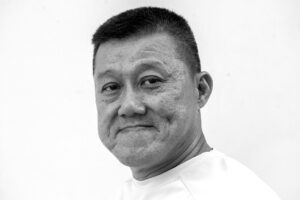

Azman JAAFAR was an avid reader when he was young and carried his love for words into adulthood. He has built a flourishing career as a lawyer and is now the Managing Partner of RHTLaw Asia and chairman of ASEAN Plus Group, an alliance of leading law firms. While his background and interests may mark him as a potential political candidate, he believes that he can contribute more by remaining in the private sector. Calling himself a ‘red and white’ Singaporean, he says he is “one of those who is ready to die for his country”.
I’d like to start by asking about your childhood. Where did you grow up and who were your parents?
My mom was a homemaker and my dad was a teacher.
Much of my childhood was spent in Tanglin Halt, which is part of Queenstown.
Queenstown was among the first few satellite towns alongside Toa Payoh. The whole area is presently being redeveloped.
Our home was a three-room HDB flat, which was pretty much the standard in those days.
Which primary school did you go to?
I studied in Delta West Primary School, which was quite a distance from home.
It was in the Kim Seng Road and Havelock area and I had to take a van to school.
The school is no longer there.
How did you end up in a school so far from home?
I believe my parents applied to some schools in our neighbourhood, but I can’t remember which ones. I didn’t get into those.
I didn’t know school admission was already competitive back then.
I think it was more a question of how space and resources were allocated. I have no idea how the decisions were made but I’m sure there was no AI involved back then.
Going back to your parents. I understand that your dad, Jaafar Latiff, was an artist, and quite a famous one.
Yes. Dad painted. Many of the paintings in our office are his works. He passed away in 2007. My parents have two children — myself and my younger brother who lives in Melbourne. I am the family custodian of my dad’s paintings.

What is the age gap between you and your brother?
He is two and a half years younger.
So you lived only in the Tanglin Halt area as a kid?
We moved to Bukit Merah Central around 1977, after my PSLE.
Our new place was a brand new five-room HDB flat.
"If we could travel to Malaysia for a holiday, it would be a treat. I think the farthest we went was to Penang. That was a big deal, a really big deal."
Maybe this whole idea of upgrading has always been a Singaporean thing.
I think we just wanted a bigger flat. The block is still there. Flats back then were bigger than the new ones you see today.
How would you describe your upbringing? Comfortable?
Reasonably comfortable. Dad was a teacher and it was hard to imagine how much he used to make.
When my mom was still alive, it was something she would tell us over and over again.
She would say, “You know, your dad used to make $112 a month.”
But of course back then, a bowl of mee was probably 5 cents or something like that.
Out of the $112, he would give $50 to his mother, my grandma.
The rest would go to him (our family). There wasn’t much extra money circulating around at that time. But life was simple.
If we could travel to Malaysia for a holiday, it would be a treat. I think the farthest we went was to Penang. That was a big deal, a really big deal.
And travel to Malaysia was always on one of those express buses.

What kind of student were you?
I was an inquisitive boy and a teacher once wrote in my report book that I was a “pleasant boy to teach”.
I think one of the best things dad ever did for us was that come school holidays, we would visit MPH at Stamford Road to buy books.
So I have been an avid reader since I was in primary two.
"I think one of the best things dad ever did for us was that come school holidays, we would visit MPH at Stamford Road to buy books."
What kind of books did you read?
Enid Blyton’s Secret Seven. Most kids today wouldn’t read Secret Seven. I wasn’t a Famous Five boy.
I also read Alfred Hitchcock’s The Three Investigators. I used to consume a book a day during the holidays.
Reading makes you more comfortable with language, because it teaches you new words and how to use them.
My wife and I try to encourage our children to read, because I think reading helps you with language. I was also a young boy with a TV addiction.
I learned a lot of words from watching TV. Maybe that was how I became very talkative because I was eager to use the words I had picked up.
Going back to you as a student …
I don’t think I was studious. I just enjoyed studying.
I started doing better in school when I was in primary three. It was probably around then that I first learned what ‘first in class’ and ‘first in standard’ meant.
I remember mom asking me, “Why are you first in class but third in standard?”. My reply was, “What is third in standard? I don’t know.”
Thankfully, they don’t band students like that anymore.
"I don't think I was studious. I just enjoyed studying."
Did your academic performance change subsequently?
Well, it got worse. I became 10th in standard although I had progressed to an A class.
By primary five, I was third or fourth in class and come primary six I was 10th or 13th in class.
Of course I knew my parents were wondering, “What’s going on? You were first before and now your results are becoming worse.”
I think I tried to explain that others just got better and better.
Who was the disciplinarian at home? Mom or dad?
When I was younger, it was mom who made me learn my spelling and so on. But to be honest, my parents pretty much left me to my own devices. I would devour my books and was happy playing Lego and watching TV.
I know you speak Mandarin and that you mentioned that you studied Chinese as a second language. Is your mom Chinese?
My mom is ethnically Chinese but culturally Malay, because she was adopted by a Malay family when she was young.
When she had dementia, she told us many things she never discussed with us before.
She passed away in 2021.
Did she meet her birth parents?
No. It’s something that didn’t bother me, but I was curious. I took DNA tests to find out who might be a close relative.
She was born Chinese, raised in a Malay family, but you ended up taking Chinese?
I learnt Chinese because my dad believed that as Singapore is 75% Chinese, it would be more beneficial to learn Chinese.
He told me,” Malay is not a difficult language. You can learn Malay at home.”
"I learnt Chinese because my dad believed that as Singapore is 75% Chinese, it would be more beneficial to learn Chinese."
How’s your Malay compared to your Chinese?
It used to be worse. Worse in the sense that I spoke Malay with a terrible English accent.
I think I picked up a lot more Malay in NS. Later in life, I did quite a bit of work in Malaysia and Indonesia and I picked up Bahasa Indonesia along the way.
I also brushed up on Mandarin when I travelled to China quite a fair bit for work in the early 2000s.
What’s fascinating about language is that it provides a very strong supporting structure for many things that we do, from the cultural point of view.
Culture brings people together. When you understand another person’s language, you can easily get into the person’s psyche. Without language, there’s a barrier.

Which is why you keep emphasising reading?
Well, I don’t think I looked at it that way then. I enjoyed reading. I suppose back then, there weren’t a lot of other distractions.
Do you make time to read now?
I think when I get into proper retirement, I probably would find more time to read.
When I started law school in 1986, it was probably the first time I had to read so much for my studies.
I’ve never read so much in my life before law school, but the reading habit helped.
"I think when I get into proper retirement, I probably would find more time to read."
Maybe your overall grade would have been better if Chinese was not your second language?
I still keep in touch with some of my primary school friends, and especially two girls who were always first and second in class and standard.
The one who was always first, who had gone to RGS (Raffles Girls’ School), told me some years ago when we met, “You always got As for English, science, maths, but what pulled your overall grade down was your second language.”
She was right. When others were getting 98, 90 or thereabout, I was averaging 60, 65.
I guess if my Chinese grades were higher, things could have been different. But that is also assuming that I would do well or better in Malay, something which we will never know since I didn’t study Malay language.
I did not study Malay formally and I picked up Malay from my day-to-day conversations with my mother. With my dad, we usually conversed in English.
In today’s world, those who can afford it will put their kids who are not good in their second language in international school.
But in today’s world, 65 is probably also quite acceptable.
Back then, getting 60-65 was not okay.
What did your father teach?
He taught applied arts in Baharuddin Vocational Institute and people like master potter Iskandar Jalil were his contemporaries. My father taught many artists including Esther Tay, a pioneering fashion designer and dressmaker.
"My father taught many artists including Esther Tay, a pioneering fashion designer and dressmaker."
So are you the most successful alumnus of Delta West?
I don’t think so. It is not important.
I think primary school life was quite straightforward in a sense. Not a lot of pressure. I mean, pressure in exams and all that, but not the kind of scholastic pressure that you would have to confront in secondary school. In secondary school, things became more complicated.
Was there a huge change?
I think there was a marked change in terms of expectations. I went to a neighbourhood secondary school. This is of course, you know, maybe news to some and maybe not news to others.
You went to Bukit Merah Secondary?
That’s right.
I was head prefect in my primary school and I was also head prefect in my secondary school.
In secondary school, we were blessed that after Secondary 1, we had this fantastic new principal called Mrs Mok Choon Hoe. She basically uplifted the school.

Did you stay all four years?
Yeah. I had a wonderful relationship with the principal. I could walk into her office and speak to her.
I also had a great form teacher who I still keep in touch with. She was very frank and honest with me and she enjoyed teasing us a lot. I just enjoyed my time in secondary school.
But Bukit Merah could not have been your first choice.
Oh, it wasn’t. My first choice was Raffles Institution (RI).
Of course my parents were upset that I did not get in.
We contemplated getting a transfer but I told my dad that we have a new principal and she’s quite a feisty person and I think I should sit this one through.
Back then you were making your own decisions. Most kids would yield to their parents.
My dad never told me what to do.
He asked for my opinion and respected my decision.
At that time, my school was embarking on a pilot programme called the Being and Becoming Programme, a form of moral education.
The Ministry of Education was looking to introduce a moral education programme that was not tied to religion. So, it’s a bit of an upgraded version of civics or 好公民 (hao kong ming), but taught in English.
It sounds like teachers have played a huge part in your life.
Oh yeah. Teachers played a very important role in our formative years. I don’t know whether I would have had the same experience in a different school. Sometimes I wonder if we were just lucky.
"Teachers played a very important role in our formative years. I don't know whether I would have had the same experience in a different school. Sometimes I wonder if we were just lucky."
I’m sure you’ve heard this a thousand times. I thought that you were an ACS boy.
Okay, there is a reason for that.
Because of ACJC (Anglo-Chinese Junior College)?
I went to ACJC after secondary school and I asked myself what I needed to do to fit in.
Perhaps I didn’t want to be left out. FOMO (Fear Of Missing Out), in today’s language.
The good thing is the experience probably led me to develop skills related to working with people, working with clients, developing relations.
Are you proud that some people think you were from an elite school?
No, not really. I would laugh about it. In ACJC, many friends who were from ACS would say things like, “I remember you were seated by the window in secondary two.” I would say, “Bro, I wasn’t there lah.”
So what was it like to go from a neighbourhood school to ACJC with a lot of students from feeder schools like ACS and MGS?
I knew I should focus on what I needed to do for it to work for me, to fully benefit from the new environment.
So not getting into RI was not a big deal?
I don’t have regrets not going to RI. It didn’t bother me that Bukit Merah Secondary then had a “gangsta” reputation.
We had a very good principal and teachers. I also had a very good drama teacher. Although I was from the science class, I participated in the drama festival and it was extremely fulfilling to be able to do so many things.
One of the greatest achievements was we got into the quarter-finals of the then SBC (Singapore Broadcasting Corporation) debates.
Were you one of the debaters?
I was the anchorman.
"One of the greatest achievements was we got into the quarter-finals of the then SBC (Singapore Broadcasting Corporation) debates."
So that was when you were in Secondary 3 or 4?
I was in Sec 4. And there were only two secondary schools. The other was SJI. The quarter-finals were all televised.
And the other schools were junior colleges?
There was Temasek Junior College and its speakers included Ivan Heng, the theatre actor and director.
National Junior College was also there.
You mean you were debating people older than you?
Yeah, because it was open to secondary schools and junior colleges.
Did that plant the thought of you becoming a lawyer?
No, I actually wanted to be a doctor. But then again, it was my parents who planted those thoughts.
"I actually wanted to be a doctor. But then again, it was my parents who planted those thoughts."
They wanted you to be a doctor?
Yeah, Asian parents always want their children to be a doctor, a lawyer, or a pilot.
So that’s why you were in the pure science stream?
I was in pure science all the way to junior college.
When did law school come into the picture?
I spoke to my teachers, mostly from my secondary school. One of them said, “Azman, I always see you as a lawyer because you love to talk. You can also be a doctor too, but it’s your call.”
I think life would have been very different if I had opted for medicine.
Law isn’t that bad right?
Law today is a lot tougher than say, 30 years ago.
I think you have to be one of the top students to be in law school and medical school.
For law school, first thing they do is they look at your overall grades, whether you fall within the band. The other is that they look at your GP grades. I could be wrong, but I think the minimum is B3.
And what was your GP? A1?
A2.
When you decided on law instead of medicine, how did you break the news to your parents?
I don’t remember. Parents are parents. I don’t think they actually knew what the studies entailed.

Despite your dad being an educator.
Yeah, but I think he was looking at it from the point of view that in life, no matter what you choose to do, you have to struggle. You must learn how to struggle to get to where you want to go.
"You must learn how to struggle to get to where you want to go."
Which you did.
Which I think I did. It’s just like choosing a wife. You do not know how things will turn out. Nobody knows, but we must all make the best of what it is.
So was law school a breeze or was it tough?
Well, it’s got its cycles. In the first three years, I think I did well enough to feel happy.
Throughout law school, I was with NUSSU (National University of Singapore Students’ Union), I was with Law Club. I was doing other things apart from studying.
I always had to manage my time. It was the same in secondary school. My principal had to chase me away from school before exams.

I was going to ask about your ECA in school.
Most of my ECA in secondary school was NCC (National Cadet Corps). I enjoyed the discipline and getting physically sweaty and dirty. I was terrible at sports and football. I played football because everyone was playing football but I wasn’t good at the game.
Do you watch football?
I’m what they call a nominal Liverpool fan. If you ask me who’s the captain, I don’t know.
Why Liverpool?
I have a lot of friends who are Liverpool fans. A lot of my clients are Liverpool fans.
The NCC experience must have been useful for National Service?
Yes and no. NCC was just the tip of the iceberg, getting you to understand what is discipline. You know, we did have a technical handling test for the AR-15 rifle and that gave me a head start in stripping and assembling weapons in BMT lah. I did NCC all the way until my junior college. I was a cadet lieutenant in junior college as well.
After medicine and law, what would have been your third choice?
I don’t know. If you ask me what I enjoy doing now, I can tell you I enjoy winning clients over. It’s about being aware and sensitive, it’s about reading the cues, it’s about understanding the language. It’s about learning to say the right thing at the right time.
A client needs to know that you’re competent to advise him.
But a lot of Asian clients also want to know that you can be trusted and that you are the right person to look after their interests.
"If you ask me what I enjoy doing now, I can tell you I enjoy winning clients over."
Do clients consider other things beyond your legal expertise?
I think 90% of the time, clients ask you about a lot about other things before they talk about business.
So they can size you up?
Well, not necessarily so. Clients are never one-dimensional.
They will say, “Let’s go and have dinner.”
Sometimes the conversation will be about their children, sometimes it’s the business, sometimes their business partners. On occasions it’s about the other family, and so on, which sometimes I find fascinating.
I have learnt to compartmentalise and not get too judgemental about things.
Your role is not just about offering legal expertise.
It’s about bringing in the clients, managing the clients, building revenue streams from the clientele that we have.
It’s not about how competent you are. It’s about whether you’ve earned their trust to be their counsel. And then the competency issue comes in. So in other words, even if you are very competent, but if you can’t build the confidence and you can’t build the trust, you’ll never get the work.
"It's not about how competent you are. It's about whether you've earned their trust to be their counsel."
I counted and you changed jobs more than 10 times, if not more. Is it common in the legal profession or are you just a restless person?
In my early years, I needed to learn to be uncomfortable because I was getting too comfortable in my first job.
There were seven of us in a cohort and six had moved on. I was the only one left. I asked myself, “Other people are experiencing new and different things. Why am I still here?”
I’ve always wanted to be my own boss and I learned a lot by managing my own practice. Everything I espouse today, whether it’s related to collecting money or how I treat clients, was what I learned in the six and a half years when I was on my own with two other partners.
So there was always a good reason to move.
That was always a good reason. And it’s never because I wanted to leave.
Your CV looks like someone who should be in politics. Why haven’t you joined politics?
I will neither confirm nor deny that I’ve been approached.
I feel that entering politics is a decision that has got to be made by the family, because it takes a lot of time away from your loved ones.
I also believe and this is something I learned from my dad, that if you ever want to go into politics, make sure that your grounding is strong because if your grounding is not strong, you will have fewer options.
"I feel that entering politics is a decision that has got to be made by the family, because it takes a lot of time away from your loved ones."
How did that become a topic of discussion with your dad?
When these discussions took place, I was a young lawyer.
I think he probably thought that one day I might consider getting into politics.
Dad would tell me things like, “Look at this guy. He was very young and he was ‘co-opted’ into politics at a young age. And he cannot carry his own weight.”
You could say I wanted to be my own man. But more importantly, I knew I had to sacrifice my family life. I was also very young and wanted to focus on growing my career.
But you were active in grassroots work?
A close friend was asked to run for office and after he was elected, he asked if he could nominate me for a town council appointment.
I was keen to make sure I was actually going to do meaningful work.
It was a fulfilling stint for me and that led to other appointments.
But not enough for you to take the extra step?
Well, I enjoyed what I did. I still enjoy my current work. I enjoy the travelling and dealing with challenging clients.
I don’t want to lose that. Politics will limit what I can do because I’ll be in the public eye.
There will be many Malay or Muslim politicians who will do well and get very far in the political system, be well-respected and achieve a lot for not just my community, but also for Singapore.
But in the private sector, there are not as many Malay Muslim business leaders and I think that my place is in the private sector.
"Politics will limit what I can do because I’ll be in the public eye."
It’s interesting that you say that. I guess in your opinion, public service is not just about politics lah. In becoming a successful businessman and a lawyer, you are also doing public service.
Business will never stop you from serving in other portfolios. When I serve in these portfolios, I don’t have to worry like a politician would worry. I can be myself.
You were on the board of NAC (National Arts Council) and now SOTA (School of the Arts). Are you an art lover?
I bring to the board a deeper understanding of how artists think and feel.
"Because of my dad. I can explain how artists feel. I can understand the sensitivities."
Because of your dad?
Because of my dad. I can explain how artists feel. I can understand the sensitivities. But I’m not an art historian like T.K.Sabapathy or one of those curators who can tell you how Singapore art has evolved. But I grew up around artists who were associated with my dad, such as Thang Kiang Hao and Ng Eng Teng.
Could you have become an artist?
No. It skipped a generation. My brother, who was trained as an architect, is probably a better painter. But he is not a professional.

Why were you involved with TKGS (Tanjong Katong Girls’ School)? I understand you were chairman of the school advisory council (SAC).
That one was a family thing because my wife was from TKGS. She insisted that our girls go to TKGS.
So instead of your wife serving, you did?
She served as well, in the parent-teacher association called “Parent Link”. I was in the SAC.
The principal told me, “I know you had served in the CDCs, so you understand how this works. Can you serve in the SAC?”
It was to get our first-born into TKGS. So we sold our souls to the school to get our first-born into the TKGS.
How did you meet your wife?
We met in law school. Salina (Ishak) is a judge and no, she is not related to Yusof Ishak.
Tell me more about your own family.
We have two girls and a boy.
Our eldest, Dian Sofia, is 31, married, and lives in London. She’s in the creative industry.
She was our first-born that got into TKGS. She struggled a little in school but it all turned out well in the end.
The teachers were very supportive. In fact, because I sat on the SAC, the teachers and the principal talked to me and said, “How’s Dian? How’s she doing? You know, at school she’s like this, you know, blah?”
She was always the school’s official photographer and our cameras were always at her disposal.
After her O-levels, she did graphic and media design at Temasek Polytechnic.
A lot of her lecturers were my late father’s former students.
She was on the Dean’s list when she completed her first year. For someone who did not do art in secondary school, we thought it was quite a feat.
We had told her that if she did well, we would send her to either London or New York. But we decided on London because of familiarity with the city and we had friends there.
Where did she go?
She went to University of the Arts London at the London College of Communication, and she graduated with First Class Honours.
She met her British husband in London and they got married during Covid. They live in London, and he’s doing his master’s now. She works for an agency called AMV BBDO.

What about the other two kids?
Our son, Razi Ilyas, the middle child, lives in Perth. He did economics and graduated with a Bachelor of Commerce. His path is a bit different. He wants to work with children with special needs.
We respect his wish and encourage him to work towards his goal. He is currently doing his diploma to get into youth support.
And your younger daughter?
The younger girl, Zara Aaliyah, is completing her studies in environmental earth system science this year.
We’ve lost two from the nest so we told her, “You cannot leave Singapore, but you can almost ask for anything you want.”
It’s not fair to her.
She’s okay with it. She went to the UK to do her exchange.
She’s studying at NTU (Nanyang Technological University), the Asian School of the Environment.
She’s what you call an environmental scientist.
"If (my children) had studied law, then I would have to worry about things like conflicts of interests or whether they could get into a good firm."
So none of your children did law? Are you disappointed?
No, I think it’s one less headache. If they had studied law, then I would have to worry about things like conflicts of interests or whether they could get into a good firm.
Even if you get into a good law firm today, it’s not easy. It’s long hours.
I was going to ask, lawyers are well-known for working insane hours. Has that culture changed?
No, it’s pretty much the same. Ours is a service industry. If my clients are based in Chicago, I can bet you my calls will take place anytime from 10 o’clock tonight to 2 o’clock the next morning.
When we have a deal which has to be completed in three weeks, all our online or virtual calls or all the conference calls are going to be during those weird hours.
Lawyers are naturally conservative because of our training and as a result we are very slow to change.
All these have an effect on our minds and the way we look at the world and how we tend to say no from the starting block.
“No, this cannot be done. This needs to do this. This needs you to do that.”
You are married to another legal mind. So who usually wins in arguments at home?
If you want peace at home, avoid arguments. Always decide on what is important and then act accordingly.
It’s not true that just because you’re a lawyer and are married to one, you will always end up arguing.
I think if you’re a good lawyer, you always know when you can give in without losing. When I negotiate, I always look at what is in my client’s best interest and not what is just irritating. I try not to be irritating.
One should negotiate in such a way that your counterpart will not feel threatened.

"If you want peace at home, avoid arguments. Always decide on what is important and then act accordingly."
Again, it seems to be more than about practising law.
It’s more than law. A lot of it is psychology.
I’m going to ask something sensitive. Are race-specific policies in Singapore still necessary?
I like to think not.
My view has always been that a lot of this has got to do with timing — when is the right time for us to be rid of all these markers.
You’re an anomaly in your community.
I’m an anomaly because of my professional achievements, my circle of friends, and my outlook?
I must admit, I have not been involved in a lot of Malay-centric activities, or Muslim-centric if you like, but more recently I’ve been involved in the Wakaf Masyarakat Singapura (WMS) Protem Committee, helping to develop a concept for a sustainable business model for WMS.
I have been trying to find time to give something back to the community.
You would be in the minority to think that race-specific policies should be done away with?
I also grew up with Malay friends who are more pragmatic.
This friend, a very senior figure in the community, once told me, “You know Azman, we live in a multi-racial country that’s surrounded by heavily Malay-Muslim populated countries. If you were to put yourself in the shoes of the Chinese, you would probably understand the anxiety and the concerns better.”
I expected my son to be called up for NS. If he had not been called up, I would have kicked up a big fuss. I am one of those who is ready to die for his country.

"I am one of those who is ready to die for his country."
And you have personally made some breakthroughs or witnessed some changes?
I believe that with NS, with in-camp training, with the different roles I have played in my NS brigade and all that, I understand things more.
When I look at my company, my battalion, my men, I say, “That’s my Malay sergeant, that’s my Chinese CSM (Company Sergeant Major), those three machine gunners are buddies to one another, those two are my Malay medics.” You know how good they are? I would like to think that any aggressor would think twice before attacking us.
I realise that this is something unique which we have, which a lot of countries cannot replicate. Of course we have limitations too, but we have chosen a different path to overcome those limitations.
Your life appears to be smooth sailing. There must be something that wasn’t smooth sailing for you.
Maybe I won’t call it a setback, but I suppose if you ask me what I might think as challenging, it has to do with the business.
Doing business in Asia is a lot about trust, having connections and getting into business communities.
I’m ethnically not Chinese and as a result I’m not in the clans. So I can’t get into certain places or build relations with certain groups of people which some of my peers are very good at.
But you have found your footing in Indonesia?
Thanks to my first boss, Arthur Loke, who told me very early in my career to focus on Jakarta, and the Indonesian market.
As a young lawyer, I was sent there to meet a particular client, and to visit certain law firms. I was young and I didn’t know exactly what to do. But I started learning then how the Indonesians do business, how they think, and how they value trust.
Today,I still attend to our clients by visiting Jakarta once a month.
If we were to compare your life journey to that of Singapore’s, what are the similarities?
It’s actually very similar. Our firm is built on a lot of fundamentals that are similar to how our forefathers built this country.
If we don’t have something, we ask ourselves, “What do we need to do to get it?” Acquire? Don’t be afraid to ask.
Make friends. Be humble enough to learn from others.

"Make friends. Be humble enough to learn from others."
Do you attach any significance to the fact that you were born in 1965.
I think not. Being born in 1965 means you’re probably a cross between a babyboomer and a Gen X, which means you’re probably that guy who knows what it is like to go from using a 14.4 modem to fibre optics.
It doesn’t make you extra patriotic?
Patriotic? I think Singapore seldom talks about patriotism.
We have discussed this in committees I sat in — how to communicate to our soldiers why they must fight.
This concept of patriotism is something that is very difficult to not just cultivate but to also explain to our stakeholders and to our people; citizens of a very young nation.
We don’t have 500 years behind us to talk about how our forefathers fought for whatever. But we will fight for our friends, our families and our way of life.
What kind of Singaporean are you?
Red and white. I believe that if you are with the country, it’s got to be 150%.