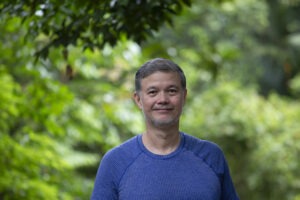

Felix CHEONG wanted to be a doctor when he was young but his A-level results were not good enough to get him into medical school. He could have settled for his second choice — pharmacy — which would have led to a stable job. But he took the curve ball life threw at him and decided to follow his passion — to be a writer.
Where was your first home and what are your memories of your childhood?
I spent three or four years of my early childhood in a kampong in Lorong 3, Geylang.
I don’t remember much of that period, except this rattan chair that I loved. I have an old photo of me on that chair. I’m not sure why I remember nothing else but that chair.
When the kampong was due to be demolished, we moved to a one-room flat in Pipit Road in MacPherson.
I guess that was when you were about five?
Yes. My brothers and I slept in the living room. My parents took the bedroom.
How many children did your parents have?
Four. I have three brothers — one older, two younger.
"Life was pretty basic, but we were not living hand to mouth. We didn’t have much, but we had enough to get by."
What was it like growing up?
Life was pretty basic, but we were not living hand to mouth. We didn’t have much, but we had enough to get by.
Mom gave us a lot of jotter books to draw and scribble, to keep us out of her hair.
We were given a lot of room to play and we learned to draw on our own. I used to like sketching Ultraman and Batman. There was also music being played around the house. Dad had this mix tape of 1950s hits by people like Connie Francis, Ricky Nelson and Pat Boone, and I loved playing it on an old cassette player.
That was probably how we cultivated our love for the arts.
I eventually became a writer and Philip, two years younger than me, became a graphic artist. He’s now a videographer with SPH.

And the other two brothers?
Christopher is one year older than me. He was a teacher for many years but is retired now.
Callistus, my youngest brother, was born in 1972. We are seven years apart.
Callistus is a very Catholic name.
Yes, all our names are very Catholic. I was named after St Felix, I think. Or maybe Felix the Cat! I was teased a lot about my name in school. My classmates would sing: “Felix the Cat, the wonderful, wonderful cat!” Well, quite appropriate, since I love cats and I have two now.
Did your parents wish they had a daughter?
Well, Mom had always wanted a girl, so there was talk in the early 1970s of us adopting one of my cousins on Mom’s side.
They were trying for a girl but the fourth child turned out to be another boy. Some Chinese families would kill to have four boys.
That was before the Two is Enough campaign kicked in?
Yes. Callistus was born around the time the campaign started.
Back then, there were a lot of discriminations and restrictions for families with more than two children. I’ve published two flash fiction stories poking fun at this policy and its unintentional consequences for people.
"Back then, there were a lot of discriminations and restrictions for families with more than two children."
Were your parents born Catholic?
Both of them converted to Catholicism much later in life.
Catholicism figured prominently in my family, and throughout my life. Dad was a warden in church. I grew up watching him serve the community. And singing hymns. And reciting the Our Father and Hail Mary prayers.

Obviously, they tried to pass that on to all of you?
My big brother became an altar boy first and I joined him later. I remember when I was in primary six, I was named model server of the year as I had put in the most hours serving mass.
I think Catholicism had a profound impact on my writing. I remember Mom had bought these Chinese books with pictures of Jesus or of a bearded white man up there in the clouds. The pages were also filled with lurid images of hell, like what you see at Haw Par Villa. That put the fear of God in me.
Does this idea of heaven and hell creep into your writing?
It does. I have written a number of poems questioning my faith and coming to terms with it, although I would hesitate to call myself a Catholic writer. I’m just a writer who happens to be Catholic.
"I have written a number of poems questioning my faith and coming to terms with it, although I would hesitate to call myself a Catholic writer."
I was going to mention guilt is fodder for the imagination.
Yes. Not love, but guilt.
Because guilt has that negative energy that drives you to wonder what you could or might have done, but didn’t. That weight stays with you and finds its way into your psyche.
How long did you stay at Pipit Road?
For seven or eight years, before we moved to a three-room HDB flat in Upper Boon Keng Road, which is walking distance to our old kampong in Lorong 3, so it was a kind of homecoming. But, as with most old buildings in Singapore, that block in Upper Boon Keng, like the one in Pipit Road, has been demolished to make way for taller and bigger flats.
After Upper Boon Keng, we moved to a four-room HDB flat in Tampines.
Why the frequent moves?
This is what Singapore calls social mobility, always upgrading.
So from a one-room flat, we moved to a three-room flat, then to a four-room flat. But it was always in the eastern part of Singapore.
When I got married, I also remained in the east and moved to a HUDC flat in Bedok Reservoir. My then-wife and I also lived in a condo in Yishun for a year. In the mid-1990s, Yishun was a new town and hadn’t earned its reputation as the twilight zone of Singapore. But I didn’t enjoy living there.
"So from a one-room flat, we moved to a three-room flat, then to a four-room flat."
So why always the east?
Well, I love the vibes, the older buildings, the fact that there’s a certain mystique and mystery about the area. We are Easterners through and through.
After a year in Yishun, we moved to Bedok Reservoir and later, Upper East Coast. By then, my folks had moved to Bedok Reservoir. My three brothers, when they got married, bought flats around there too.
After my divorce, I rented a room in Frankel Avenue for a year.
Finally I moved to Marine Parade, where I still live.
Was your mom a homemaker?
No. She took on a lot of odd jobs in different factories. She was not educated and spoke only Chinese.
At one time, she worked in the assembly line at the Rollei camera factory in Chai Chee. She also helped her sister sell eggs door to door. In today’s parlance, she’d be called a gig worker.
For a short spell, she was a bus conductor on the (now-defunct) City Shuttle Service. Remember those bright yellow buses?
I remember a conversation she had with her sister about how passengers would rub against her on the crowded bus. You know those chikopehs (dirty old men).
Was your mom born in Singapore?
Yes. She came from a not so well-off traditional family which favoured boys.
She didn’t get much of an education but, like the baby-boomer that she was, she was quite the rebel.
I remember her telling us that her grandmother wanted to match-make her to this well-off guy. But she chose to go with my dad.
How did your parents meet?
I have written a cute-meet short story about them. It’s published in an anthology of love stories which I edited, A View of Stars: Stories of Love.
We actually did not know about their love story until Uncle Peter, dad’s oldest friend, told us their backstory at my dad’s wake in 2020.
Although my parents grew up in the same kampong, Dad was too shy to approach Mom.
So Uncle Peter and Uncle Freddy, one of dad’s younger brothers, enrolled dad in a night school where Mom was studying.
A night school?
Yeah, to learn Mandarin. They were hoping Dad would make his first move.
But even after he started the night classes, he was still too shy.
So my uncles cooked up another scheme. They asked a friend to write a note in Chinese, asking Mom out.
Pretending to be your dad?
Yes, pretending to be my dad!
So he was quite mystified when a couple of weeks later, he got a note from her agreeing to go out with him. The rest is my family history.
Was your dad educated?
He was educated until primary 6 at Gan Eng Seng. But he had to drop out of school to support his family. It was a big family. He had five younger siblings. My grandfather had passed away very young from a stroke, so Grandma needed Dad to pull his weight as the second oldest child in the family.
He took on an apprenticeship at The Straits Times Press, which eventually became Singapore Press Holdings (SPH).
He was a printing technician?
Yes, and it is quite apt that I became a writer, isn’t it?
Dad was in the printing trade, and I am in the writing trade.
In fact, he was the one who taught me how to type. He bought me my first typewriter when I was in secondary 2.
I remember it was an Olivetti.
After I had mastered two-finger typing, he asked me to write his job application letters. He moved between jobs often because he had quite a temper. He was constantly rubbing people, especially his bosses, the wrong way.
So even though he rose through the ranks to become foreman, he often fell out with his boss.
I know you went to SJI (St. Joseph’s Institution), but what about primary school?
St. Anthony’s Boys’ School at Victoria Street. It’s now a co-ed school located in Bukit Batok. Mom told me she had to beg the parish priest to write a referral letter to get me into the school. She had done the same a year earlier to get Christopher into Catholic High School, which used to be at Queen Street, a short walk from my school.
We didn’t have any connections. But Mom, like most Asian parents, believed that studying in a reputable school is the first step in being made for life.

"We didn't have any connections. But Mom, like most Asian parents, believed that studying in a reputable school is the first step in being made for life."
You were in the school band in SJI. Why not LDDS?
I was in the LDDS (Literary, Drama and Debate Society) too — I represented my class in the inter-class debate in secondary 2. We lost to a team that had Alec Tok, a Red Dot United candidate in the 2025 General Election, as its anchor speaker.
Being in the school band fuelled my love for music. I grew up listening to oldies from the 1950s. I later discovered the Beatles, which were the biggest influence on my writing. I was fanatical about their music and spent hours transcribing their lyrics. Something about the musicality of their lines has filtered into my writing.
There were many pirated cassette stalls in Bugis Street and I bought these $2 cassettes of their albums before I could save up enough to buy my first vinyl record. This was way before Bugis Street was cleaned up. I was so innocent then and didn’t realise that area had so much vice.
Were you the only one in your family who went to university?
No, Callistus also went to university. Christopher did a degree correspondence course with Murdoch University.
What did you study in university?
I did two majors at NUS (National University of Singapore) — English Literature and Philosophy and a minor in English Language.
So the expected path for you would have been to become a teacher?
Let me backtrack a bit.
In my JC (junior college) days, I wanted to be a doctor. I was in the pure sciences class in CJC (Catholic Junior College). Half my classmates are now doctors or dentists. But my A-level results were not good enough.
When I applied to NUS, I got a place in pharmacy instead.
But during my NS, I decided this was not what I was cut out to do.
I didn’t want to spend the rest of my life telling patients: “Here is your medicine, take it three times a day. When you finish, come back and see the doctor, OK?”.
My interest at that time was leaning towards literature.
Your parents did not worry that you weren’t going to be an engineer or a doctor?
My parents never forced me, or any of my brothers, onto particular career paths. They said I could do whatever I was passionate about, and it was all right with them.
Can’t help wondering if you would have given up medical school if you had gotten in.
They say life throws you curve balls but in this case, it was a straight ball that hit me right between the eyes and woke me up, that I wasn’t meant to be a doctor.
Not many people think of poets and writers as professionals.
I knew I wanted to be a writer when I was 14.
At that point, I had a number of short stories published in student magazines. I had also won a couple of competitions, including a consolation prize at the courtesy short story writing competition.
These prizes made my folks very proud.
You know, one reason that I write is to make them proud. I was very moved when I was clearing out their stuff at their flat, after their passing, and I found a folder of newspaper clippings about me. They had kept them after all these years.

What were you reading at that age?
I started off reading poetry.
In the mid-1980s, I remember attending an NUS extramural class in poetry appreciation conducted by Max Le Blond, the academic and pioneering theatre director.
He introduced me to writers like Sylvia Plath, whose ‘Daddy’ poem still resonates with me.
You do not do, you do not do
Any more, black shoe
He also introduced me to T.S. Eliot.
That got me interested in poetry.
I developed that interest in NUS and wrote my own poems and found like-minded friends to hang out with, like singer-songwriter Kelvin Tan and poet Boey Kim Cheng.
"I knew I wanted to be a writer when I was 14."
I guess you breezed through university since you were studying something you like. Then after that?
Not at all! Remember, I didn’t study Lit at A-Levels. I jumped from O-Level Lit to university-level literature. The first semester was tough trying to get up to speed.
After graduation, I was bonded to SBC (Singapore Broadcasting Corporation). I was one of their scholars. In my honours year, I had applied for their scholarship and gotten it. For a one-year scholarship, I was bonded for two years.
And what did you do at SBC?
I started out as a research writer and became a producer later. First it was with Sunday Morning Singapore, which you might remember. Then later, I produced the gag show, Gotcha!
And after completing the bond?
I left to join CNBC Asia as a studio director. I was there for 7½ years.
I was also writing poetry on and off.
In 1997, I finished my second manuscript. I had stopped writing poetry for five years after my first manuscript was rejected by Landmark Books.I destroyed that bloody manuscript.
What was your first manuscript about?
I can’t remember. Some juvenilia nonsense. The poetry was so bad, I don’t think I want to remember it or want to be remembered by it.
So you destroyed the whole thing and wrote the second one. Wow.
The second manuscript, Temptation and Other Poems, was accepted by Landmark Books and published in 1998, together with the first collections by Gwee Li Sui and Alfian Sa’at.
And now three of you are titans in the local scene.
It has taken us 25 years to get there.
How would you describe that journey, now that you are near middle age?
I am middle aged, not near. There have been so many ups and downs.
Ups, in terms of receiving the Young Artist Award in 2000. That made my folks very proud.
"I am middle aged, not near. There have been so many ups and downs."
Do you remember who nominated you?
My editor at that time, Winnie Wong, from Ethos Books.
I got the award and at the same time, I was also a recipient of the NAC bursary to pursue my master’s in creative writing at the University of Queensland.
Were you bonded for that?
The only bond was that I had to come back and work in Singapore, which I did.
And you have since written 32 books.
In the past four to five years I must have written 12 to 13 books. Some of my friends call me a book-making machine. That hurts, because it seems to suggest I churn out my books mechanically. I don’t. Every book is a challenge, a wonder, a mystery, a joy, an insight into myself.
I think it is my way of telling people that I still matter. As you age, the opportunities dry up, be it in how receptive publishers are to your pitches, or how often invitations from festivals come your way.
It’s an issue few people talk about or even acknowledge, that there’s ageism in the publishing industry. People call me ‘prolific’ but they do not know half the story. They think it’s easy for my books to get published, but they do not see how I have to work twice as hard to overcome the impression that I’m past my prime and a has-been. I have to keep reinventing my writing.
Over the past seven years, I have received so many rejections from publishers, NAC (National Arts Council), NHB (National Heritage Board) and NLB (National Library Board). I have decided that rejections fuel my soul.
To be fair, I have received a few grants over the past two years. First, the NAC-NLB Writer’s Lab in 2023. Then the NLB Creative Residency last year. More recently, the SingLit Adaptation Subsidy for my graphic novel, The Showgirl and the Minister. But still …

"It’s an issue few people talk about or even acknowledge, that there’s ageism in the publishing industry. People call me ‘prolific’ but they do not know half the story."
Let’s talk about the big rejection, that wake-up call.
I think it was in 2017 or 2016 when I pitched my manuscript of poetry to Ethos.
A new team had taken over from founder Fong Hoe Fang.
They said that they wanted a change in the editorial direction, to focus more on culturally relevant topics and themes.
That rejection was a big blow to my ego but also a turning point.
So the rejection was not entirely negative?
With the benefit of hindsight, in fact, a blessing. But at that time, I felt very downcast.
I had to think deeply about how poetry could be bent and reshaped into other forms, other mediums, and how this might enable me to reach new audiences.
It must be scary to venture out of your comfort zone.
It was scary at first, but I’d done it before.
Even before this big rejection?
I had started changing my style, my approach, when I was doing my master’s in Brisbane. That’s reflected in my third book, Broken by the Rain.
So it wasn’t the first time I was re-pitching my writing, but this time I was moving into new genres.
So I had to first learn a form inside out. I started studying it, reading a lot of books in that genre before I understood it.

A lot of people think that creative folks are so egoistical about their art that having to change is like chopping off one arm.
It won’t do to keep writing the same book over and over again. At least that’s my take. You’ll get bored, your audience gets bored and eventually you run out of things to say.
Did you find new publishers?
I had to find new publishers.
For example, I found out that Straits Times Press was publishing children’s picture books and I’d always wanted to try that genre. So I pitched a book idea to Susan Long, then the general manager of ST Press.
She liked it and we had a great working relationship for three books before the company took a different editorial direction, cutting back on fiction and children’s picture books.
Then I had a wonderful working relationship with Melvin Neo, my editor at Marshall Cavendish. He was very open to my venture-adventure into illustrated poetry and graphic novels.
I think finding like-minded collaborators and being able to work with them is the most interesting lesson I’ve learnt over the past nine years.
Think of it as being on a trampoline. Without the trampoline, you can jump only so high. But with a trampoline, you can jump much higher.
"I think finding like-minded collaborators and being able to work with them is the most interesting lesson I've learnt over the past nine years."
Can you take us through the process of working with collaborators? What comes first, your words or the drawings?
The first meetings are usually casual and over coffee.
With Arif Rafhan, my collaborator over five graphic novels, it was over Zoom because he’s based in Malaysia.
These initial meetings allow us to know if we have a certain mind meld. What the person’s interest is, art style or whatever.
After that?
I come up with a storyline and ask for input.
And then I’ll write the story. I have to now write into empty spaces where the illustrations can come in.
As a poet, I’m writing for the reader and the text just goes on the page.
But now I have to leave sufficient gaps for the illustrator to work his magic. I have to visualise first what the page will look like.
Is it a one-way traffic or is it often two-way? Do the drawings affect your writing?
It’s two-way.
In fact, I have been corresponding with an illustrator for my next book. He has drawn several pages for which I now have to write dialogue.
So now I have to fill in his gaps just as I have to leave gaps for him to fill.
In this kind of collaboration, is there a need for a leader? Or is it always by committee like the two of you?
It’s usually the two of us although I’m often the story generator.
I come up with the storyline. But they will offer their feedback.
For example, in our last book Be Real: A Guide to Authenticity, Arif felt that the main character was not likeable enough. The story is a satire, and my take was that satirical characters are often not likeable anyway.
But I took onboard his feedback and had to rethink the character, his flaws, and what I could introduce into his personality to make him at least more sympathetic.
Does age make you more open to compromises or does it make you more stubborn?
Not so much compromises as consensus.
I learn to take on other ideas and adapt my writing so that the whole work becomes better.
What can we expect after this graphic novel phase in your life?
At the moment, I am not done with the graphic novel form. I’ve three more books in the pipeline.
Once these three books are out, I might have to think about how to usher my writing in a new direction.
What does your son think of you as a writer?
He has read my works, especially all my graphic novels. He gives me feedback on whether they work for him or not.

Do you get into arguments with him?
No. He is a lawyer, for God’s sake!
What is it like to be married to someone who is also in the creative industry?
We bounce ideas off each other and we’re each other’s cheerleaders. She’s often my first reader.
I will ask her to read a few pages and she will comment, “This doesn’t work” or “this character is a bit too needy”.
So she’s sometimes my harshest critic.

Does it affect the marriage?
No, of course it doesn’t.
I think it’s good that I subject myself to scrutiny. Public scrutiny is a lot worse.

What about plays and screenplays?
At the moment, not yet.
I have written a couple of plays. Hoh Chung Shih, a composer, took one of my short plays, Inconvenience of Minor Parts, and adapted it into an opera. This was staged at the Esplanade Concourse in 2023.
What about song lyrics?
I’ve collaborated with songwriters like Jean Tan, Beverly Lim Morata and Ting Si Hao.
Has there been a book that you absolutely hate? That you wish you could recall every copy and burn it?
There were several books but I wouldn’t go as far as to burn them. I might just rewrite them.
Is it because you have become better?
I’ve grown older and become a different person.
So I would have written things differently. But mind you, every book published at a particular time of my life is a combination of my experience up to that point and my writing ability up to that point. So it’s a crystallisation of who I was.

Are you worried that young people are not reading anymore?
Yes, it’s a concern.
For example, when I gave workshops in schools I sometimes sold my books at the end of the workshops. And usually students bought the books.
But these days, I notice that students are not buying books.
Why do you think people are not buying books and not reading?
It’s the allure and temptation of the mobile device.
Because the source of entertainment is no longer just books. It’s video games, it’s streaming movies, it’s chatting on social media. There are so many other distractions.
But yet at the same time, a lot of people attend your workshops and take your classes. What are they hoping to do?
They hope to improve their writing.
But reading feeds your writing. Nothing goes in, nothing comes out. So I’m quite concerned that those who want to be writers are not actually reading.
"Nothing goes in, nothing comes out. So I'm quite concerned that those who want to be writers are not actually reading."
Have you asked them, “You don’t even read, why are you writing?”
They do read but they tend to read a certain type of genre. They are not reading widely. A lot of young people, for instance, tend to read fantasy, or manga.
But you need to vary your diet, otherwise you get stuck with too much of the same thing.
Writers need to be exposed to different influences.
I bet you have never imagined saying exactly what your parents used to say?
Thirty years ago, the older generation writers were looking at us as a threat, surging forward to take their place.
Now I’m seeing a new generation of writers surging forward to take my place.
But I don’t see them so much as a threat. I see them more as continuing the journey of writing in Singapore, Sing Lit.
So I try to pass on my knowledge as much as I can before I leave this earth.
That’s why I’m running a lot of workshops and giving back, paying it forward.
Everybody is talking about using AI and ChatGPT in creative writing.
A few months ago, I asked ChatGPT to write a poem in the style of Felix Cheong. And it came up with a very good poem, something that I could have written.
I showed it to Boey Kim Cheng and he said, “The two of us can stop writing already.”
Maybe that’s a new genre.
Well, I tend to see AI more as a collaborator.
I’m not shy to admit that I have used AI for plot generation.
ChatGPT is very good at cobbling together bits and pieces from all the published material, all the existing databases.
So, for example, for my graphic novel, The Showgirl and the Minister, I asked it to help me generate a plot. It did, but it was very clichéd.
So your job as a writer is to vary the template. Take this particular bit, and then you push it along in a direction you think fit.
But at the end of the day, it’s still your book, your human touch. I still have to give my own input and populate the plot with characters that the reader will care about.
Do the young people who attend your workshops or classes only see the glamorous side of being a writer?
Many have this big illusion that they will be the next JK Rowling or the next Stephen King.
So at the end of every workshop, I try to debunk all these myths. I tell them that it’s not that easy getting published, especially being published overseas. And you can’t really earn a living from writing alone. You need a day job.
How do you make a living as a writer in Singapore?
I make my living primarily through teaching. Writing alone is not enough to keep body and soul together.
Will you ever retire as a writer?
Probably not. I see active ageing as active writing. Or active writing as active ageing.
Because as you’re writing, your brain is always thinking, musing, constructing, inventing, creating. So I guess in that sense, it generates its own energy.
The whole research process is intriguing in itself. It takes a lot of digging into, it arouses your curiosity, keeps you interested and active in the world.
Hopefully that will keep dementia and all the bad things at bay.
"The whole research process is intriguing in itself. It takes a lot of digging into, it arouses your curiosity, keeps you interested and active in the world."
What can we expect you to do in the next 5 to 10 years?
I’ve got, as I mentioned, three more graphic novels lined up.
You’re always not happy with what you’ve done, always trying to look for ways to improve yourself?
Yes, it’s a self-examining process. It’s putting a mirror to my own writing and asking how did I come to this point or how did I arrive at this particular shape of the story or the particular form that the story eventually took.
You were born in the year Singapore became independent. In fact, just three days before Aug 9. Do you attach any significance to that?
Not so much significance. Salman Rushdie has written about how people who were born in the same year as their country often carry the weight or burden of the country, as though the sins of the country are buried within them.
But I don’t buy that. I feel that it is just a myth, although I always feel sayang (it’s a pity) that I miss the public holiday by three days.
How would you like to be remembered?
As someone who has done his part for the literary scene. Someone with a wry sense of humour, who has a way with language.