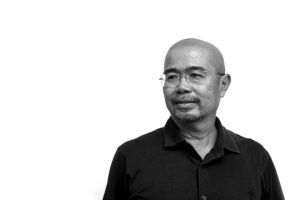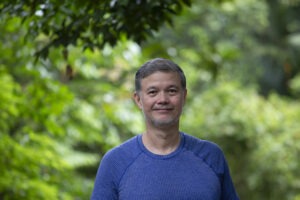

Terence ANG suffered a stroke at 55, at the prime of his career, when he was handling multi-million dollar advertising budgets. Stubborn and ignorant of the seriousness of his condition, he assumed he would recover fully within weeks. Five years on, his memory of pre-stroke days is still fuzzy, his speech is often slurred and he needs someone to accompany him when going outdoors. But he has found his voice sharing his journey to recovery, and has written five books and counting.
Let’s start with your childhood.
Unfortunately after my stroke, I have forgotten a lot of things. So I have to check with my sister and my partner. Maybe you can help me by asking specific questions.
Ok, let’s start with where you grew up, the first home you can remember.
I grew up in a kampong environment in the Kim Keat Road area, before the HDB flats were built. It was the kind of place where neighbours knew one another, and children played outdoors until the sun went down. It was a simple, close-knit community.
And after that?
We moved to a two-room HDB flat in Jalan Tenteram, which is near St. Michael’s Estate, also not far from Kim Keat.
How long did you live in the kampong before moving to a HDB flat?
I don’t know.
How many siblings do you have?
There are five of us. I’m in the middle, the third. I have two older brothers, one younger brother and a younger sister.

Your dad was a policeman?
Yes. He was a personal security officer to some cabinet ministers. Dad was the disciplinarian, while mom was the emotional heart of our family.
"Dad was the disciplinarian, while mom was the emotional heart of our family."
When you say he was a disciplinarian, you mean he was a very strict person?
My father was a strict and ‘arrogant’ person. My mom always quarreled with him and she would say, “If you were clever, you would be very rich now. All your friends are so rich. People will make use of you because of who you know.”
We were not wealthy but there was love at home.
So your mom was angry that your dad had the connections with influential people but he refused to take advantage of that?
That’s right. My dad was not someone who would yield easily to temptations or favours. So mom got angry with him a lot.

Is your dad still around?
He passed away in 2012.
But your mom is still around?
My mom passed away a year later (2013) after a stroke.
How old was she when she had the stroke?
She was in her 70s.
Is there a part of you that wishes you had treated her differently during that difficult time?
I had no idea what a stroke was at that time.
To me it was just one of the illnesses where people would just get better after a while.
I did not fully understand the physical, emotional and psychological toll that it took on her.
I saw the changes, but I did not truly understand the daily battles she faced. While I was supportive, I could not truly appreciate the depth of her struggle.
Looking back, I wish I had been more patient, more present and more empathetic.
I have nothing but admiration for her strength. Her journey became a quiet source of inspiration in my own recovery.

"Even after suffering a stroke, I thought that I would become well within two weeks, three weeks, or at most one month."
You don’t think much about such things until they hit you.
Even after suffering a stroke, I thought that I would become well within two weeks, three weeks, or at most one month.
Then before I realised it, two months became three months.
I told the doctors and nurses that I wanted to leave the hospital and live a normal life.
But they said, “No, you can’t.”
I told them, “If you don’t let me go home, I’ll tell the hospital to stop anyone from visiting me.”
And that would include my sister, whom I am very close to.
Threatening to bar visitors was not about pushing people away. It was a cry for independence, for normalcy. Inside me, I was in pain, scared, grieving the sudden loss of the life I knew. At that vulnerable moment, I was trying to reclaim some power over the situation. It was about wanting control in a situation where everything felt out of control. It was frustration, grief, and desperation speaking.

I want to go back to the day when you had your stroke. It happened in 2020? Do you remember the date?
It was August 25th.
Can you tell me what you were doing?
I had dinner with my partner and then I went to shower.
Suddenly I just fell and could not move.
But I managed to scream for help.
This was at home?
At home. We eat a lot at home because my partner is a very good cook.
Did your partner call an ambulance immediately?
Ya, at first my partner thought that I had slipped because the floor was slippery.
Seeing the state I was in, my partner suspected it was something more serious and quickly called an ambulance.
And then you were rushed to nearby Sengkang General Hospital?
No! They had to rush me to Changi General Hospital.
I think it was because they didn’t have the facilities in Sengkang.
You were unconscious for a few days?
I was conscious on the way to the hospital but after I was admitted to A&E, I lost consciousness.
The A&E doctor told my sister to prepare for the worst as I had a hemorrhagic stroke, and things did not look good.
"The A&E doctor told my sister to prepare for the worst as I had a hemorrhagic stroke, and things did not look good."
What was your reaction when you first learnt that you had a stroke?
I had no idea what was a stroke.
You didn’t have a reaction, except that you were confused?
When I regained consciousness, I could not talk. I was mumbling words that did not make sense to anyone.
You couldn’t express yourself?
Yeah.
Did you blame yourself?
I don’t think so, because at that time, I thought it was just a simple illness and I would get well soon.
You were sure that you were going to recover?
Yeah.
Even after three months, I still thought that I would be okay.
Soon after that, I realised that it’s going to be a very, very long haul.
"Even after three months, I still thought that I would be okay."
You mentioned your sister more than anybody.
She’s very close to me.
How old is she now?
Early 50s.
She’s married?
Yes.
So apart from your partner, she’s the only other person who took care of you?
Sort of, in a way, because she lives nearby. Whenever we need her help, she would always come.
How long have you and your partner been together?
31 years.
Your first job was in marketing?
I began my career as a fashion buyer and was part of the pioneering team that introduced renowned Japanese brands such as Íxi:z, D’urban and Intermezzo in the 1980s.
I later transitioned into fashion styling and had the privilege of working with creative icons like Michael Chiang.
Throughout my time in the fashion industry, I worked with some of Singapore’s most celebrated photographers and many celebrities.
The creative industry — fashion styling, retail, media, advertising, promotions, events — was where I thrived.

"The creative industry — fashion styling, retail, media, advertising, promotions, events — was where I thrived."
When you had your stroke, you were working for a consumer electronics company?
I was head of digital marketing and e-commerce when it happened.
You didn’t leave immediately? The company let you stay on for a while?
I was on medical leave.
I went back to work three days after being discharged from the hospital, of course with my walking aids.
But my boss was always hinting that I should take it easy.
Eventually, I quit.
How long were you with the company?
Five years, if not more.
Are you still hopeful that you will recover fully?
Of course.
Dr Moses Koh, the rehabilitation medicine doctor treating me at Sengkang General Hospital, always says this to me, “You are at 70% (in terms of recovery) now. You are one of my star patients.”
My reply is always, “Sorry, I’m 20% only.”
I never say “No” to things that he wants me to try doing.

"While I had a public-facing, social side, I am actually quite the opposite in private."
Just based on your IG, it appears that you were a really social and party animal. Is that impression wrong?
That is a fair impression but only partially true. While I had a public-facing, social side, I am actually quite the opposite in private. I prefer intimate gatherings over good food or simply relaxing with a drink among family and friends.
I did enjoy the so-called “good life,” but I also held myself and others to high standards. I was KPI-driven, often demanding at work. My team bore the brunt of that pressure when things did not go well.
After the stroke, that chapter of my life took a backseat. Life slowed down, and I found a different kind of joy — one that is quieter but deeper.
Are you religious?
Used to be, but not anymore. I’m a Christian.
So faith did not play a part in your recovery? You didn’t pray, you didn’t ask for help?
I still do, at least in my heart I do.
But in my mind, I wonder why God has given me such a setback in life.
"... in my mind, I wonder why God has given me such a setback in life."
Someone told me you are very tech-savvy.
Really? I learn fast lah, but I don’t think I’m that savvy.
I would say that before my stroke, I was very good.
I still post regularly on Facebook and Instagram, but with these platforms becoming increasingly complex, it takes much more effort to learn and navigate the new features and express myself after my stroke.
When I write to you, you always email back almost immediately.
Email is easy. But stuff that I was able to do easily in the past, like expressing my thoughts and speaking my mind take a lot more effort now.
You said that you wrote your first book because someone from SPH invited you to write about your experience.
The person who asked me used to be my good friend. We worked together at a magazine.
When she first broached the topic, I told her, “Other than magazines that feature my fashion work, I don’t even read. I don’t know how to write a book.”
But she said, “You can do it.”
We spent a lot of time discussing the book and the title was hotly debated. We finally agreed on the title A Cry in the Dark.
When she approached me, the COVID pandemic was at its height and she wanted to play up the COVID angle.
How long after your stroke did the publisher approach you?
Maybe within a year.
What has COVID got to do with your stroke?
To many people then, COVID was a big thing. They tried to make a link to that.
By the time my book was ready, I said, “Nobody is talking about COVID now, I want to change it.”
There were also guidelines on how many words each chapter should have and the order to follow, so I had to work within that framework.
This can be challenging as there were things where I had more to talk about and things where I had less to talk about.
So you didn’t like the structure? You found that restrictive?
Yeah, so we ended up fighting every day over the book.
It was clear that our views of how the book should be done were very different.
"It was clear that our views of how the book should be done were very different."
So in the end, what happened? You compromised?
My book was scheduled to be launched at a book fair. If I didn’t come up with it, we would have to wait one year.
So I said, “Okay, whatever.”
Were you not happy with the first book?
It is in fact my favourite. But the title was not my first choice.

Did you design the cover?
No, the publisher had a creative director to design the cover.
As for the illustrations inside the book, the publisher initially found an illustrator and when I saw his work, I liked it.
But Dr Koh asked me, “Why don’t you draw your own illustrations?”
I said, “I can’t even draw.”
He said, “Try”.
At that time, I had not regained the full use of my right hand.
But encouraged by my doctor, I tried. Then I actually did it. My drawings appeared in my first and subsequent books.
Have you drawn before?
No, never.
You draw on the computer?
No, on paper and then I scanned the drawings.

Wow, you’re quite incredible. Suddenly you have developed a new talent.
I would not call it talent. It was more like an accidental discovery! Dr Koh just told me to take it slow, and somehow, things started to come together.
What keeps you going despite the adversities?
The response to my first book unexpectedly opened doors. I began connecting with stroke survivors around the world. Each person’s story is unique although the common themes of struggle, resilience, and hope are in all of the stories. Their courage inspired me.
"The response to my first book unexpectedly opened doors. I began connecting with stroke survivors around the world."
Did your previous job involve a lot of writing?
In a way, yes. I was in marketing.
So for you to pick up writing was not so difficult?
Yes and no. Because of aphasia, my ability to formulate and comprehend language is affected.
For instance, I would say that I want chocolate ice cream when actually, I was thinking strawberry.
Oh, okay. There is a disconnect.
Yes!
So my partner brought back a tub of chocolate ice cream, and I got angry.
“I told you strawberry, why are you giving me chocolate?”
And then my partner shouted back, “No, you told me chocolate.”
That’s tough. It can cause so many misunderstandings.
That’s right.
Can I ask you about your writing process? Do you dictate?
I usually write on my phone first. These could be observations, or fleeting thoughts.
Then I put all my notes together on my computer.
But subsequently, you also use AI (Artificial intelligence)?
I did not use AI for any of my books. AI is a recent discovery and it helps me organise my thoughts, expand on ideas that are hard to put into words, and shape my narrative when speaking is a challenge.
Living with aphasia, I’ve found AI to be an invaluable tool. AI supports my thinking process and gives structure to my work, but it can never replace my own voice or emotions.
You mentioned collaborators.
I have some editor friends, all of them people I know from my previous jobs.
You send your drafts to them and they help you?
Yes, I send them my drafts and they give me honest feedback. They help make sure my thoughts come across clearly, without changing my voice. It really helps having people who understand me and know where I am coming from.
Most people cannot even write a page about themselves, but you have five books to your name so far. Take us through your creative process.
It is not easy. Especially with aphasia.
Writing has become my therapy, my outlet, and now my “lifestyle”.
My mind is constantly generating thoughts, and I make it a point to jot them down. Over time, I shape them into coherent stories.
"Writing has become my therapy, my outlet, and now my 'lifestyle'."
Has the writing journey been tough?
Very, very tough. And it’s not just the writing.
I used to be someone who avoided the spotlight. In fact, at the launch of my first book, I told the organisers to seat me at the back and not to mention my presence. I warned them that if they announced I was in the audience, I’d get up and leave.
So people were left wondering, “Who’s this Terence Ang?”
It was hard. Already I felt my life was so cham 惨 (miserable). Writing was my way of coping but putting myself out there was a whole different struggle.
Can you explain what you mean? It was tough to write the book or it was tough to have to live with the effects of your stroke?
As I said, I didn’t know what stroke was.
So having to recall what happened and to write about it was like reliving those unhappy days.
The first few chapters were very painful.
But after a while, I realised that there were many things I could do with my words.
I also discovered things that I was previously too busy working to notice.
"I also discovered things that I was previously too busy working to notice."
For instance?
Before my stroke, I didn’t even know who were my neighbours.
Every day, I would just go downstairs, wait for my Grab ride, go to work, then come home.
Because of my stroke, I had to go walking to regain my strength, so I would use the PCN (Park Connector Network), and I realised, “Wow, this part of Punggol is so beautiful!”

And you got to know your neighbours?
Yes. We didn’t talk to one another before.
At my book launch, someone sent me a bouquet of flowers.
The card said, “From Mr Cheang & Family”.
I received a lot of flowers, but who is “Mr Cheang & Family”?
When I ran into my neighbour later, I asked him, “Are you Mr Cheang?”
And he replied, “Ya, We read that you have a book launch, we wanted to go but couldn’t. So we sent you the flowers.”
Wow, that is so nice. And now are you a little bit of a celebrity in this area?
Yes. Quite often, strangers would come up to me and ask, “Are you Terence Ang? I have read your book” or “I read about you”.
Just last week, it happened when we were on a MRT train.
So that gives you the motivation to carry on?
In a way.
After my first book, Dr Shamala Thilarajah, then president of Singapore National Stroke Association (SNSA), said to me, “You have a voice. I think you’re good. Can you speak at this and that event?”
I told her, “No, cannot. I can’t even talk properly. I can’t.”
But hey, you are speaking quite eloquently now.
Now can. But when there are a lot of people, I will still panic a little.
Because of my aphasia, I got some help with my public speaking.
Evelyn Khoo, a speech therapist and the founder of Aphasia Singapore and Chit Chat Cafe, has become a friend.
She helped me to shorten words, especially words that are very difficult to read.
You know, when you write, it can read very nicely. But when you speak, it’s very difficult.
So with Evelyn’s help, I spoke at the World Stroke Congress in Singapore in 2022.

So, at first you insisted on not showing your face at events and interviews. And then you realised that you should put yourself out there.
I want to be an advocate for certain things. But people ask, “Who is this person? Who is Terence Ang?”
So, I’ve realised that I have to do it.
Do you think of it as a sacrifice or it’s okay?
It’s a sacrifice of my privacy.
I used to be invited to events.
Let’s say a movie premiere. I would be the first person to go into the cinema and the first person to leave. People would go to the cocktail parties. I would not. I just disappeared.
You are writing a script to make a movie?
Yes, I like movies. And I’m also writing a play, something that I really wanted to do even before my stroke.
So the play and movie will be about your life?
No. I try to make sure that not everything is about strokes.
Of course I’m a stroke survivor. My play will also touch on mental health, which I think is an important issue.
I want to give a voice to people with disabilities, not just stroke survivors.
"I try to make sure that not everything is about strokes."
When do you hope to make this movie?
I don’t know, but the play is definitely next year.
Which company is staging the play?
I’m still talking to a friend who has done some small productions.
Healthcare is very expensive. How are you financially?
I’m fortunate to have a supportive partner. I think we will be okay.
Have some friends abandoned you after your stroke?
Oh yes, many.
In the past, because of my job, I had big advertising budgets to spend. Now I no longer have that kind of influence or reach.
I’m grateful that some are still here for me when it matters.
You have received many awards for your books.
Yes.
Did you attend all the ceremonies?
No. These were all in the US. The recent one is in Los Angeles.
Are you planning to go to Los Angeles?
No. But there is a big one in New York City in November. I really want to go to that.
I asked my doctor, “Can I go?”
He said I can but I am scared of the long flight. I think it will be very challenging because I can’t sit for long.
My leg stiffens and goes numb if I stay still or seated for too long. My movement will be impacted.
"My leg stiffens and goes numb if I stay still or seated for too long. My movement will be impacted."
Sometimes you are an Ang and sometimes a Fong. Eh, which one is correct?
(Laughs) It is Ang. Fong is part of my online handle. Ang is my surname. Confusing, I know.
Despite the impression that I am a social creature, I am actually very much a behind-the-scenes person. Terence Fong became something of an alter ego, a way for me to avoid being at the centre of attention.
What is the thing you miss the most now?
I miss the lively, spontaneous conversations with friends.
I used to be very articulate. My command of language was my strength. Losing that ability to aphasia has been one of the hardest things to accept.
Have you recovered your speech 100%?
No, I have not. I do not think 100 percent recovery is possible.
Some days are better than others. Aphasia is unpredictable. I may fully understand a conversation but still struggle to find the words.
Writing helps me express what I cannot always say aloud. I am still me but the way I communicate has changed.
We are all born in 1965, the year Singapore became independent. Does it have a huge significance for you?
It does make me feel extra special.
Like Singapore, I’ve had to rebuild my life in many ways. After my stroke, everything changed. I had to start over, physically, emotionally, and mentally. In that process, I found new purpose through writing, just as Singapore found its voice and identity on the global stage.
Singapore is constantly adapting to economic, social, and global challenges with resilience and determination.
Likewise, I have challenges in my own journey as a person with disabilities. Though the path hasn’t been easy, I continue to evolve, to grow, to contribute, and to believe that I still have something meaningful to offer.
Like the country, I’m a work in progress.
"Like the country, I’m a work in progress."
I’m guessing you must be a very proud Singaporean.
Yes and in some ways more so now than before.
In recent years, I’ve seen more effort being made to ensure inclusivity, especially for people with disabilities. That wasn’t always the case in the past. It felt like our voice wasn’t really heard.
But now, there’s a growing awareness. We still have a long way to go, but I’m proud to see progress and to be part of that journey.
When you say “inclusivity”, are we talking about LGBTQ+?
No, no. My advocacy is centred on persons with disabilities, particularly stroke survivors and those living with aphasia. While I recognise the importance of other communities and causes, such as LGBTQ+ rights, they are not the focus of my work
While working on my second book, stroke survivors told me that some people did not think stroke was an important issue.
Many people believe that as long as a stroke survivor can walk again, then it is ok already.
After your third to sixth month, you’re out of the system. You’re on your own. To me, that’s not ok.

But it is slightly better now?
Probably, but I think there is still a lot of room for improvement. Post-stroke care needs to go beyond just the first 3 to 6 months.
Recovery can be a lifelong journey for many. Long-term support is essential,yet overlooked. With stroke affecting more people, including younger adults, the system needs to be reviewed to better meet these evolving needs.